We value your privacy

We use cookies to analyse site traffic and improve your experience. You can accept all cookies or reject non-essential ones. See our Privacy Policy for details.

GR IT SERVICES
  • Contact
Get a quote
  1. Security & Compliance
  2. Microsoft Purview
Microsoft Purview

Microsoft Purview, data governance with audit-ready evidence.

Get a Purview quoteSee capabilities
Microsoft
Microsoft
Purview
Cloud Solution Partner
  • 50+Purview tenants
  • AuditReady evidence
  • DLPTuned policies
  • 24/7Coverage
Microsoft Purview
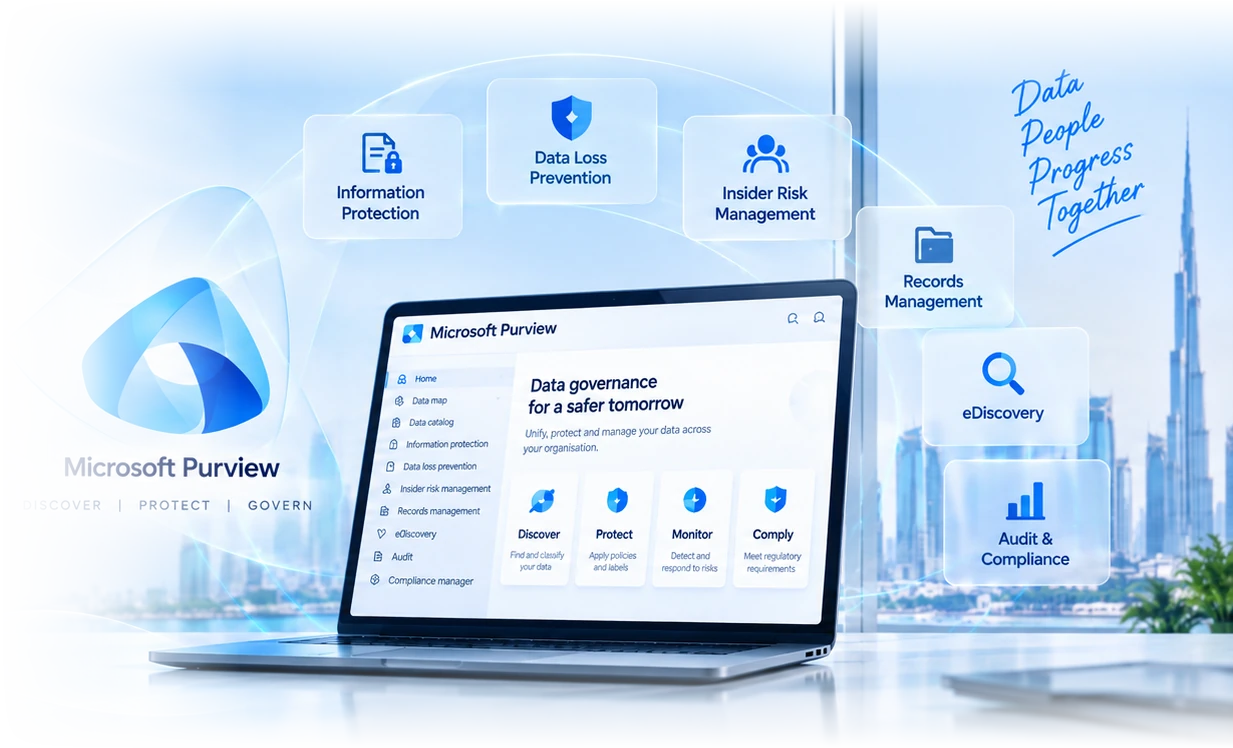
What Purview delivers

Six data-governance disciplines, one platform.

Purview is the data side of compliance. Classify, label, protect, retain, audit, investigate, all in one platform aligned to your regulatory framework.

Information Protection

Sensitivity-label schema designed for your business, deployed via Office, Outlook, SharePoint, OneDrive, Teams. Auto-labelling for common patterns, manual labelling supported with policy.

Data Loss Prevention

DLP policies for email, SharePoint, OneDrive, Teams, endpoints. Tuned for false-positives, integrated with Defender for Cloud Apps for SaaS coverage.

Insider Risk Management

Behavioural anomaly detection across user activity. Flagged exfiltration, departing-employee monitoring, data-leak prevention before incidents become breaches.

Records management & retention

Retention labels, retention policies, defensible deletion. Compliant with ADGM, DFSA, healthcare records retention, and other industry requirements.

eDiscovery & legal hold

Premium eDiscovery for litigation and investigations. Legal-hold workflows, custodian management, search-and-export across the M365 corpus.

Audit & compliance

Unified audit log across M365, configuration history, compliance score against frameworks (ISO 27001, NESA, NIST, GDPR). Audit-ready evidence.

Microsoft Purview Solutions

Three Purview workstreams that turn governance into evidence.

Purview is a suite of solutions, not a single product. We deploy each workstream against your regulatory framework, with the tuning that turns Microsoft defaults into audit-ready posture.

Risk Management

Behavioural risk detection across user activity, communications, and access patterns. Insider Risk, Communication Compliance, and privileged-access monitoring tuned to your environment.

  • Insider Risk Management with ML scoring
  • Communication Compliance for policy violations
  • Privileged Access Management with JIT workflows
  • Departing-employee and risk-user playbooks
  • Forensic timeline for investigations

Sensitive Information Protection

Classification, labelling, and protection that travel with the data. Sensitivity labels through Office, browser, and mobile; DLP across email, SharePoint, OneDrive, Teams, and endpoints.

  • Sensitivity-label schema (auto + manual)
  • DLP across email, SharePoint, OneDrive, Teams, endpoints
  • Information Rights Management (IRM)
  • Information Barriers / ethical-wall enforcement
  • Endpoint DLP with USB and cloud-egress controls

Compliance and eDiscovery

Records management with retention and defensible deletion, premium eDiscovery for litigation, and Compliance Manager scoring against ISO 27001, NESA, GDPR, DFSA, and 300+ frameworks.

  • Retention labels and defensible deletion
  • Premium eDiscovery with legal-hold workflows
  • Compliance Manager continuous assessment
  • Unified audit log across the M365 corpus
  • Privacy Management for subject-rights requests
Microsoft Purview Data Governance Suite

Beyond M365: Azure Purview for the wider data estate.

Purview is two product families. The M365 side covers labels, DLP, retention. The Azure side, often missed, is where Data Map, Catalog, Estate Insights, and Data Sharing live. We deploy and operate both as one programme.

Data Map

Automated discovery and metadata classification across your hybrid estate. Connects to SQL, Azure Data Lake, Snowflake, S3, on-prem file shares, Power BI, and 50+ source types.

  • Automated scanning of structured and unstructured sources
  • Classification with 200+ built-in and custom rules
  • Lineage capture across ETL, ELT, and Power BI flows
  • Hybrid coverage: Azure, AWS S3, on-prem SQL, Snowflake
  • Glossary terms aligned to business taxonomy

Data Catalog

Searchable inventory of every dataset across the estate, with lineage, ownership, sensitivity, and certification. Self-service discovery for analysts without granting raw access.

  • Searchable inventory across hybrid sources
  • Owner, steward, and expert assignment per asset
  • Lineage visualisation upstream and downstream
  • Sensitivity-label propagation from M365
  • Certification workflows for trusted datasets

Data Estate Insights

Posture scoring across the data estate, sensitivity coverage, ownership gaps, classification accuracy. Executive dashboards for the CDO and operational drilldowns for stewards.

  • Posture scoring per source, domain, and owner
  • Sensitivity-coverage and classification health
  • Ownership gap analysis with remediation prompts
  • CDO dashboards plus steward operational views
  • Trend analysis across quarterly catalogue snapshots

Data Sharing

In-place data sharing across Azure tenants without copying. Share live datasets with partners, regulators, or sister entities, with revocation, audit, and expiry built in.

  • In-place sharing across Azure tenants, no copies
  • Granular share scope by table or container
  • Time-bound shares with auto-expiry
  • Audit trail of every consumer query
  • Revocation without partner cooperation required
Why GR IT for Purview

Four reasons clients pick us for the deployment.

Purview is enabled in every M365 tenant; few clients use it well. The discipline is in the deployment, the tuning, and the ongoing operations.

50+ Purview tenants

Pattern recognition matters. We have deployed Purview across regulated firms, healthcare, professional services. Common DLP traps, common retention gaps.

Framework-aligned

Sensitivity-label schemas mapped to ISO 27001, NESA, GDPR, DFSA. Retention policies aligned to industry requirements. Audit-ready by default.

Tuned, not just enabled

DLP false-positives suppressed during baseline. Insider-risk thresholds tuned for your environment. Sensitivity labels classified for actual business use.

Dubai-based engineers

Senior compliance engineers with ISO 27001 LA, CIPP, and CISM credentials. Same team that deploys operates and supports.

Industries using Purview

Purview deployments by sector.

Six sectors where Purview provides material data-governance uplift over native M365 controls.

Financial services

DIFC and ADGM-licensed firms using Purview for regulator-required retention, audit logging, eDiscovery, and DLP for client-confidential data.

Healthcare

Hospitals, clinics, medical groups using Purview for PHI protection, DHA-compliant retention, breach-investigation eDiscovery.

Professional services

Law firms, accountancies, consultancies using Purview for matter-based retention, ethical-wall enforcement, legal-hold workflows.

Tech and SaaS

SaaS companies using Purview for SOC 2 evidence, data-classification programmes, GDPR subject-rights workflows.

Retail and e-commerce

Retail groups using Purview for PCI DSS retention, customer-data DLP, GDPR right-to-be-forgotten workflows.

Education

Schools and universities using Purview for student-record retention (KHDA/MOE compliance), parent-data protection, exam-record archival.

Government

Federal and Emirate-level entities using Purview for UAE Data Protection Law obligations, NESA T-control evidence, ISO 27001 alignment, classified-data handling.

Purview vs ad-hoc compliance tooling

Why integrated Purview beats third-party DLP.

Many clients arrive after years of patchwork compliance: one DLP vendor, one retention vendor, one eDiscovery vendor. The honest comparison:
Vendors to manage
Patchwork tooling3-5+
Microsoft Purview1
Sensitivity-label enforcement
Patchwork toolingLimited (often gateway-only)
Microsoft PurviewEnd-to-end through Office, browser, mobile
M365 native integration
Patchwork toolingAPI-only
Microsoft PurviewNative, no licensing extras
eDiscovery across Teams/SharePoint
Patchwork toolingCustom export
Microsoft PurviewNative search
Audit-log retention
Patchwork tooling90-180 days typical
Microsoft Purview1+ year built-in, archive available
Total cost (mid-market)
Patchwork toolingHigher (licence stacking)
Microsoft PurviewOften included with M365 E5
Compliance Manager scoring
Patchwork tooling
Microsoft Purview
Feature
Patchwork tooling
Multiple vendors
Microsoft Purview
Integrated platform
Vendors to manage
3-5+1
Sensitivity-label enforcement
Limited (often gateway-only)End-to-end through Office, browser, mobile
M365 native integration
API-onlyNative, no licensing extras
eDiscovery across Teams/SharePoint
Custom exportNative search
Audit-log retention
90-180 days typical1+ year built-in, archive available
Total cost (mid-market)
Higher (licence stacking)Often included with M365 E5
Compliance Manager scoring
Measurable Purview impact

What clients see across the Purview programme.

Numbers from our 50+ Purview client portfolio across financial services, healthcare, professional services, and government. Averages over 12-month managed engagements.
50M+
Documents catalogued

Across the data estate, M365 plus Azure plus hybrid sources, classified and labelled in client tenants we operate.

99.9%
Compliance score

Average Compliance Manager score against active frameworks (ISO 27001, NESA, GDPR, DFSA) post-baseline.

75%
Risk reduction

Reduction in data-leak risk events measured by Insider Risk Management 12 months post-deployment.

10x
Discovery speed

Faster time-to-find for analysts using the Catalog vs raw access requests through IT helpdesk.

Start your governance journey

You do not need to deploy everything at once.

Most clients arrive without a sensitivity-label schema, with audit logging disabled, and with retention policies that exist on paper but not in the tenant. We start with a 90-day baseline (labels + DLP + audit + retention), prove value to the regulator, then layer Insider Risk, Communication Compliance, and eDiscovery as readiness allows. The longest journey starts with a single label.

  • Free 90-day baseline phase to size the programme
  • Sensitivity labels designed against your data taxonomy
  • DLP rolled out in audit-only mode before enforcement
  • Retention policies aligned to ADGM, DFSA, DHA, KHDA
  • Compliance Manager dashboards for the next regulator visit
  • Quarterly tuning to keep false-positives below 5%
Book a Purview governance review
How a deployment runs

From compliance audit to managed Purview operations.

Every Purview engagement runs the same path. Documented, evidenced, deliverable on a fixed timeline.
  1. 1

    Compliance audit

    2-3 weeks

    Current-state assessment: data classification, DLP gaps, retention gaps, audit-log coverage, regulator-framework mapping. Output: gap report and deployment plan.

  2. 2

    Schema design

    2-3 weeks

    Sensitivity-label schema designed for your business, retention policy designed for your records, DLP policies sized for your false-positive tolerance.

  3. 3

    Deployment

    3-6 weeks

    Labels deployed, DLP rolled out in audit-only then enforce mode, retention activated, insider-risk baseline established, audit logging enabled.

  4. 4

    Operate

    Continuous

    Quarterly retention reviews, monthly DLP tuning, ongoing eDiscovery support, compliance scoring, audit-evidence kept current.

“Our regulator review asked for evidence of how we handle client-confidential data. We had M365 E5 licences for two years and never deployed Purview. GR IT brought us to ISO 27001-aligned posture in four months: sensitivity labels enforced through Outlook, retention defensibly applied, audit logs preserved. The next regulator visit was answered with documentation, not promises.”
Maya Khalifa
Chief Compliance Officer · ADGM-licensed financial services firm
ISO 27001 alignment in 4 months, regulator review passed
Common questions

Microsoft Purview, frequently asked.

For full Purview functionality, yes. Sensitivity Information Protection (basic), DLP, retention, and audit logging are included with E3. Insider Risk Management, premium eDiscovery, Communication Compliance, and Information Barriers require E5 Compliance or individual Purview SKUs. We map your needs in the discovery and recommend a licence path.

Schema design: 2-3 weeks. Pilot deployment: 2 weeks. Full rollout with adoption support: 4-6 weeks. The variable is auto-labelling tuning; aggressive auto-labelling needs more iteration than manual labelling.

Three layers: in-line tuning during baseline (per-policy thresholds, exceptions, exact data matches), audit-only mode for the first 30-60 days, ongoing monthly tuning reviews. Most clients see false-positive volumes drop 80%+ after the first quarter.

Multiple retention policies on the same content can conflict. Purview applies the longest retention by default (\"win retain\" principle). We design retention schemas to minimise conflicts and document the conflict-resolution rules for auditors.

Yes. Sensitivity labels classify PII, DLP prevents leakage, retention applies right-to-be-forgotten timelines, eDiscovery handles subject-rights requests. Microsoft Priva extends this with full subject-rights-request automation. Often deployed alongside Purview.

Behavioural anomaly detection: unusual download volumes, unusual upload locations, unusual after-hours activity, departing-employee patterns. Risk scores triggered alerts to compliance team. We tune thresholds to your environment to avoid alert fatigue.

Yes. Common takeover work: sensitivity-label cleanup, DLP false-positive remediation, retention conflict resolution, audit-log enablement. Most takeovers complete in 4-6 weeks with measurable improvements in tuning and coverage.

Premium eDiscovery (E5) provides full case-management workflow: legal hold, custodian preservation, search across Exchange, SharePoint, OneDrive, Teams, export to legal-review tooling. We support active matters with same-day responsiveness.

With exports rather than descriptions, and this is where Purview earns its place in an audit-heavy organisation. The pack that satisfies most assessors covers: the classification scheme with label definitions and the guidance given to users; coverage reporting showing what proportion of content carries a label; the DLP policy set with a plain-English statement of what each rule does and evidence of matches and overrides; the retention schedule mapped to the obligation driving each period, with disposition records proving deletion actually happened; audit log configuration and retention; and access evidence for restricted categories. The point most organisations miss is that the assessor wants proof the control operates, not proof it was configured. A DLP policy that exists but has never matched anything, or a retention label applied to nothing, evidences intent rather than control. We report on operation rather than configuration for exactly that reason.

Classification, and specifically a small classification scheme rather than a comprehensive one. The instinct is to design a complete taxonomy covering every document type the business produces, and that project reliably stalls somewhere around month four with nothing deployed. What works is three or four labels people can apply without thinking: something like Public, Internal, Confidential and Restricted, with clear one-line guidance on when each applies. Deploy those, let usage settle for a few weeks, then look at where the labels actually land and build protection on top of the ones that matter. Data loss prevention, retention and insider risk all depend on classification being present, so getting a simple scheme genuinely adopted beats a sophisticated one that exists only in a design document.

Partly by not relying on them alone, and partly by making the right action the easy one. Automatic and recommended labelling does the heavy lifting: Purview can detect content patterns such as passport numbers, Emirates ID formats, IBANs and card numbers and apply or suggest a label without the user deciding. Default labels on containers mean documents created in a given SharePoint site inherit the right classification. Where user judgement genuinely is required, the guidance has to fit on one line and the label names have to mean something to a non-technical person. What fails is a training session, a poster, and an expectation that four hundred people will consistently classify documents correctly forever. We aim for automation to cover the majority and user action to be the exception rather than the mechanism.

Run everything in simulation first, without exception. Purview DLP policies can operate in a mode where they log what they would have blocked while blocking nothing, and running that for two to four weeks tells you exactly which business processes would have broken. It is always more than expected: the finance team emailing a spreadsheet to the auditor, the HR process that shares passport copies with the PRO, the sales pattern of sending contracts to personal addresses because a client asked. Some of those are genuine risks to stop, some are legitimate work needing an exception, and you cannot tell which from a policy document. After simulation you tune, then move to a warning mode where users are notified but can proceed with justification, and only then to blocking for the categories that truly warrant it. Skipping simulation is the single most reliable way to have DLP switched off by management in week two.

A retention policy applies broadly to a location, so everything in a given mailbox or site is retained for the stated period. A retention label applies to specific content, travels with the item, and can trigger different behaviour including disposition review before deletion. In practice most organisations need both: a baseline policy giving everything a sensible floor, and labels for the categories with a specific obligation such as financial records, contracts, or employee files. The trap is conflicting rules, because when they conflict retention generally wins over deletion, meaning you keep things longer than intended rather than shorter. That is safer legally and expensive in storage and in privacy terms, since data you should have deleted is data you can still be asked to produce. Mapping the conflicts deliberately is part of the design rather than something to discover later.

This is a business and legal decision rather than a technical one, and it is the point where Purview projects most often stall because nobody wants to own the answer. What we can do is bring the question into a workable shape: rather than asking how long to keep everything, we ask it per data category, and for each we ask what obligation requires retention, what risk attaches to keeping it longer, and what the business genuinely needs operationally. UAE commercial and tax record obligations set a floor for financial records, employment records have their own considerations, and contracts frequently carry contractual retention terms. Take the decisions with counsel, write them into a retention schedule, and then implementation becomes mechanical. Without the schedule, every configuration decision becomes an argument.

It provides much of the technical foundation, though it is not a compliance product and no tool discharges an obligation on its own. Classification and data discovery answer where personal data lives, which is the first question and the hardest without tooling. Retention and disposition support keeping data no longer than necessary. Data loss prevention restricts inappropriate sharing. Audit provides the record of who accessed what. Purview also underpins Priva, which is the layer specifically handling privacy risk and subject-rights requests. What Purview cannot do is determine your lawful basis, decide your retention periods, or make the notification judgement after a breach. Those are governance decisions for your privacy owner and your counsel, and the technology implements them rather than substituting for them.

Partly, and it is worth being precise because the answer shapes your data map. Within Microsoft 365 the coverage is deep: Exchange, SharePoint, OneDrive, Teams. Endpoint DLP extends to files on managed Windows and macOS devices. Purview can extend to some non-Microsoft cloud applications and to on-premises file shares through scanning, and to certain databases and cloud storage through the data map. What it will not cover is a line-of-business application with its own database, a SaaS platform outside the supported set, or paper. So a realistic data map has a Purview-covered zone and an everything-else zone, and the second one needs its own controls and its own answer for subject-rights requests. Pretending the second zone does not exist is how organisations produce confident privacy statements that fail on the first real request.

It detects patterns rather than reading content for surveillance purposes: unusual volumes of downloads before a resignation, data moved to personal storage or a USB device, mass deletion, or sharing that departs sharply from a person normal behaviour. The lawfulness question is a genuine one and the answer depends on how you deploy it. The defensible pattern is pseudonymised by default so analysts see behaviour rather than named individuals until an investigation is escalated and approved, scoped to legitimate business risk rather than general monitoring, with the policy disclosed in employment documentation, and with a defined approval path before de-anonymisation. Deployed that way it is a proportionate control. Deployed as blanket named monitoring of everyone it is a different proposition and we would advise taking employment law advice before switching it on.

Three to six months to a solid steady state for a mid-sized organisation, and the sequencing matters more than the total. Weeks one to four are discovery and the classification scheme. Weeks four to ten deploy labels with automatic classification and let adoption settle. Weeks eight to sixteen bring DLP through simulation, then warning, then enforcement for selected categories. Retention runs alongside once the retention schedule exists, which is usually the item waiting on a business decision rather than on us. Insider risk and eDiscovery come last because they build on everything before them. The pace is deliberately governed by adoption rather than by configuration speed, since every one of these controls can be technically enabled in a day and will be worked around within a fortnight if the organisation was not brought along.

Fewer people than a Purview programme usually ends up involving, but the right ones. You need somebody who can decide retention periods, which in practice means legal or finance with counsel behind them, because that decision blocks a third of the implementation and IT cannot make it. You need a business owner per major data category who can say what the classification labels should mean in their world, since a label scheme designed purely by IT tends not to survive contact with how people actually work. You need a sponsor senior enough to hold the line when DLP starts warning people, because the pressure to disable it comes quickly and from senior places. Beyond that we do the configuration, the tuning and the reporting. Where a client genuinely has nobody for the first two roles, that gap is the thing to solve before the technology, and a virtual CISO or privacy owner arrangement is usually the answer.

More than people assume, and it is worth establishing before anyone proposes an upgrade. Business Premium includes basic sensitivity labels, basic DLP for Exchange, SharePoint and OneDrive, retention policies, and basic audit. That covers a genuinely useful baseline: classify your important content, stop the obvious accidental sharing, retain what you must, and have a record of access. What E5 adds is the sophisticated end: automatic classification at scale, endpoint DLP, insider risk management, premium eDiscovery with case management, communication compliance, and extended audit retention. Our advice is usually to implement the Business Premium capability properly first, because most organisations have not, and to let the gaps you actually hit drive the licensing conversation rather than buying the tier and hoping to grow into it.

Designing the classification scheme before understanding how people actually work. The instinct is to build a taxonomy in a workshop, with labels reflecting how the organisation describes itself on paper, and then discover that nobody applies them because the categories do not match the documents in front of them. The schemes that succeed are small, use words a non-technical person recognises immediately, and lean on automatic labelling so that user judgement is the exception rather than the mechanism. Three or four labels genuinely adopted beat twelve that exist only in a design document, and you can always add granularity later once you can see where the labels actually land.
Further reading

Resources for compliance leads.

Microsoft Priva

Privacy management platform that extends Purview with subject-rights-request automation, privacy risk assessment, GDPR workflows.

Learn more

Microsoft Defender

Endpoint EDR and threat protection that complements Purview's data-loss prevention with active threat response.

Learn more

Cybersecurity audit

Independent assessment of your data-governance posture. ISO 27001, NESA, DFSA gap analysis, written remediation programme.

Learn more
Ready to deploy Purview properly?

Talk to a compliance specialist.

Three-minute form. Our compliance team gets back the same business day to schedule a discovery call. We will tell you which Purview SKUs fit your regulator and risk before you commit to a deployment.

Get a Purview quoteSee cybersecurity audit

Related Services

Explore more solutions that work great with this service

Continuous Compliance Monitoring

Control state tested daily, not annually

Learn more

Communication Compliance

Message review with pseudonymised usernames

Learn more

Data Lifecycle Management

Retention policies, labels and defensible deletion

Learn more

Endpoint DLP

USB, print, clipboard and browser controls on devices

Learn more

Microsoft Security Dubai

Entra, Defender, Purview, Sentinel, and what you already own

Learn more

Microsoft Priva

Privacy risk management and compliance

Learn more

Microsoft Defender

Advanced endpoint and email threat protection

Learn more

Compliance Manager

Regulatory compliance assessment tools

Learn more
GR IT SERVICES

Leading IT services provider in Dubai,
delivering enterprise-grade solutions
for businesses across the UAE.

Microsoft CSP PartnerCISGuard

Get the Helpdesk app

Raise and track IT tickets from your phone.

Download on the App StoreGet it on Google Play
Learn more about the app

Microsoft 365

  • Microsoft 365 Administration
  • M365 Reporting & Auditing
  • Microsoft 365 Licensing
  • Microsoft Copilot
  • Microsoft 365 Apps
  • Windows 365 Cloud PC
  • Microsoft SharePoint
  • Outlook & Exchange

Security

  • Microsoft Defender
  • Microsoft Purview
  • Microsoft Intune
  • Microsoft Entra
  • Compliance Manager
  • Cybersecurity Audits
  • Copilot for Security
  • Microsoft Sentinel
  • Microsoft Priva

Infrastructure

  • Google Workspace
  • Cloud Migration Services
  • Data Analytics & BI
  • Active Directory
  • Server Management
  • Apple Business
  • Apple Jamf Pro
  • IP Telephone
  • Data Backup
  • Website Development

IT Services

  • Managed IT Services
  • IT Support Dubai
  • IT AMC Dubai
  • New Office IT Setup
  • IT Relocation
  • Remote IT Support
  • On-Call IT Support
  • Startup IT Business Kit
  • Disaster Recovery & BC

Company

  • About Us
  • Careers
  • Contact
  • Blog

Contact

  • Iris Bay Tower, Office 903,
    Business Bay, Dubai, UAE
  • +971 56 613 2743
  • hello@gritservices.ae
  • gritservices.ae

© 2026 GR IT Services. All rights reserved.

Privacy PolicyTerms of UseCookie Policy