We value your privacy

We use cookies to analyse site traffic and improve your experience. You can accept all cookies or reject non-essential ones. See our Privacy Policy for details.

GR IT SERVICES
  • Contact
Get a quote
  1. Security & Compliance
  2. Microsoft Entra
Microsoft Entra

Microsoft Entra, identity that holds when attackers try the front door.

Get an Entra quoteSee capabilities
Microsoft
Microsoft
Entra
Cloud Solution Partner
  • 68+Entra tenants
  • Zero-trustBy default
  • AuditReady evidence
  • 24/7Coverage
Microsoft Entra ID
What Entra delivers

Six identity disciplines, one platform.

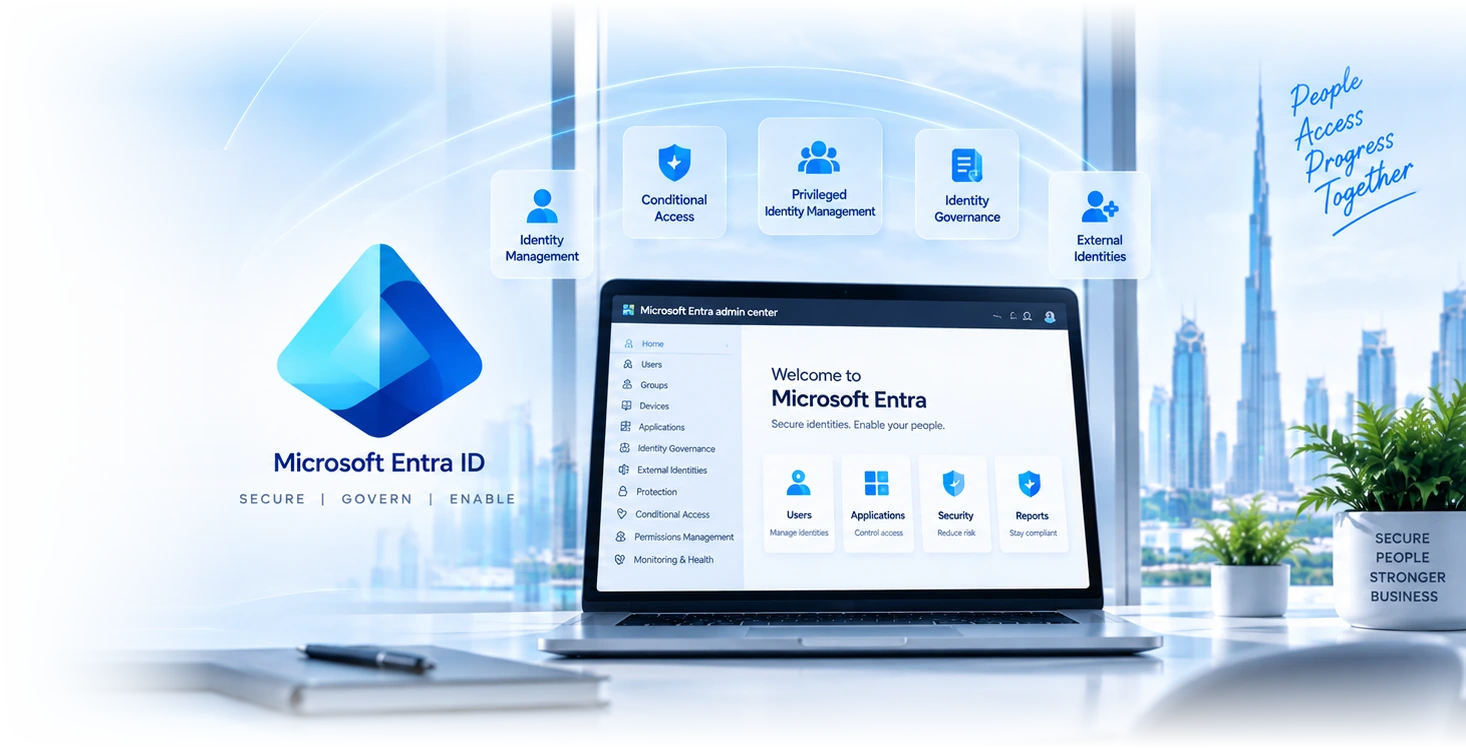
Entra is more than just AAD with a new logo. It is identity, governance, privileged access, external collaboration, and verification, all in one platform tuned to your environment.

Entra ID (formerly AAD)

Cloud identity for users, devices, and applications. SSO across SaaS, M365, custom apps. Hybrid sync with on-prem AD where you still have it.

MFA + passwordless

MFA enforcement across users, with risk-based step-up and passwordless options (Authenticator, FIDO2 keys, Windows Hello). Reduces phishing exposure and password reset volume.

Conditional access

Policy engine that evaluates user, device, location, and risk for every sign-in. Block, require MFA, or require compliant device based on context, not just credentials.

Privileged Identity Management

Just-in-time admin elevation, time-bound role assignments, approval workflows, audit logs. Removes standing-admin from the breach blast radius.

Entra ID Governance

Access reviews, lifecycle workflows, entitlement management. Joiner-mover-leaver automation, periodic access certifications, regulator-ready evidence of who has access to what.

External Identities

B2B collaboration with partners, B2C identity for customers, cross-tenant access policies. Secure external collaboration without distributing local accounts.

Licensing, in plain terms

What each Entra tier actually gives you.

The licensing page is not written for buyers, so this is the version we walk clients through. The question that matters is not which tier has more features, it is which capability you will genuinely operate. An unconfigured P2 protects you less than a well-run P1.
CapabilityFreeP1P2Who typically needs it
Multi-factor authenticationSecurity defaults onlyFull policy controlFull policy controlEveryone, without exception
Conditional accessNoYesYesAnyone with data worth protecting
Self-service password reset with writebackCloud onlyYesYesHybrid environments, cuts helpdesk volume
Group-based licensing and dynamic groupsNoYesYesAnyone above about 30 users
Identity Protection, risk-based policiesNoNoYesRegulated firms, anyone targeted
Privileged Identity ManagementNoNoYesTen or more privileged accounts, or an auditor
Access reviewsNoNoYesAnyone who must evidence access recertification
Entitlement management, access packagesNoNoYesHeavy guest collaboration, project-based access
Included in Business PremiumYesYesNoMost UAE SMEs land here
Included in Microsoft 365 E5YesYesYesMid-market and regulated
Why GR IT for Entra

Four reasons clients pick us for the deployment.

Entra deployments fail when conditional access is too strict (users locked out) or too loose (controls bypassed). Tuning is the work.

68+ Entra tenants

Pattern recognition matters. We have tuned conditional access for SMEs, regulated firms, and multi-tenant deployments without locking users out.

Zero-trust by default

Conditional access designed around device compliance, MFA, and risk signals from day one. Not "open until something breaks" then retrofit.

Audit-ready evidence

ISO 27001, NESA, DFSA reviews answered with Entra audit logs, configuration history, and access-review evidence. Compliance-ready by default.

Dubai-based engineers

Senior identity engineers based in Dubai with CISSP and Entra certifications. Same team that deploys operates and supports.

The failure we are called in to fix

MFA is on and the tenant still got compromised.

This is now the most common identity incident we respond to in the UAE, and it surprises people because they did the thing they were told to do. Multi-factor authentication is necessary and it is no longer sufficient on its own. Understanding why changes what you deploy.

  • Adversary-in-the-middle phishing defeats ordinary MFA. The victim receives a convincing link, signs in on a proxy that relays every step to the real Microsoft login, approves the push notification themselves because they genuinely are signing in, and the attacker captures the resulting session token. No code was guessed and no password was cracked. The stolen token is then replayed and the attacker is inside with a valid session.
  • The defences that actually work against it are phishing-resistant methods, FIDO2 security keys or Windows Hello for Business, which are bound to the real domain and simply will not authenticate against a proxy. Conditional access requiring a compliant or hybrid-joined device is the next best control, because a stolen token from an unmanaged machine then fails the device check.
  • The second most common route is not phishing at all, it is legacy authentication. Protocols that predate modern authentication cannot present an MFA challenge, so an attacker who finds one enabled simply uses a valid username and password and is never asked for a second factor. Blocking legacy authentication is a single policy and it closes the entire category.
  • The third is the standing exclusion group. Almost every tenant has one, created for a service account or an executive who found MFA inconvenient, and it grows quietly. Attackers do not need to defeat your MFA if there is a documented list of accounts exempt from it. Review that group today, and if it has more than break-glass accounts in it, that is where to start.
Book a free identity posture check
Industries using Entra

Entra deployments by sector.

Six sectors where Entra provides material identity and security uplift.

Financial services

DIFC and ADGM-licensed firms using Entra ID Governance for regulator-required access certifications and PIM for privileged-access controls.

Healthcare

Hospitals and clinics using Entra for clinical-system SSO, role-based access to patient records, audit-trailed identity for DHA compliance.

Professional services

Law firms and consultancies using Entra for matter-based access, ethical-wall enforcement, partner external collaboration via B2B.

Tech and SaaS

SaaS companies using Entra as their primary identity platform, customer B2C identity, dev environment SSO, secrets-management integration.

Retail and multi-location

Multi-store retail using Entra for store-staff authentication, POS device compliance, supplier portal access via B2B.

Education

Schools and universities using Entra for student SSO, parent portal access, faculty privileged identity, exam-system access controls.

Entra vs basic M365 identity

What Entra Premium adds over the free tier.

Free Entra (included with M365) covers basic identity. The licensed tiers are where the controls live. The honest comparison:
Cloud SSO
Free Entra
Entra ID P1/P2
Basic MFA
Free Entra
Entra ID P1/P2
Conditional access
Free Entra
Entra ID P1/P2
Privileged Identity Management
Free Entra
Entra ID P1/P2P2
Identity Protection (risk signals)
Free Entra
Entra ID P1/P2P2
Access reviews
Free Entra
Entra ID P1/P2P2
Lifecycle workflows
Free Entra
Entra ID P1/P2P2 + Governance SKU
Feature
Free Entra
Included with M365
Entra ID P1/P2
Licensed tier
Cloud SSO
Basic MFA
Conditional access
Privileged Identity Management
P2
Identity Protection (risk signals)
P2
Access reviews
P2
Lifecycle workflows
P2 + Governance SKU
How a deployment runs

From tenant assessment to managed identity operations.

Every Entra engagement runs the same path. Documented, evidenced, deliverable on a fixed timeline.
  1. 1

    Assessment

    1-2 weeks

    Tenant audit, current-state identity assessment, licence review, threat-model workshop. Output: identity-posture report and deployment plan.

  2. 2

    Deployment

    3-6 weeks

    SSO, MFA, conditional access, PIM, access-review configuration. Phased rollout to minimise user impact, with help-desk preparation.

  3. 3

    Validation

    1-2 weeks

    Penetration test against the deployment, simulated phishing, simulated MFA bypass attempts. Findings closed before steady-state.

  4. 4

    Operate

    Continuous

    Quarterly access reviews, monthly identity reports, conditional-access tuning, audit evidence kept current. Same team that deployed operates.

“We deployed Entra P2 ourselves and locked half our users out within a week of enabling conditional access. GR IT rebuilt the policies based on actual user behaviour, restored access without weakening the controls, and our help-desk volume on identity issues dropped 70% in the next quarter. Tuning is the discipline; we did not have it.”
Latifa Al Marri
IT Director · Mid-market financial services group, ADGM
Help-desk identity volume down 70%, controls preserved
Common questions

Microsoft Entra, frequently asked.

P1 if you need conditional access and basic MFA enforcement. P2 if you also need PIM (privileged-access elevation), Identity Protection (risk-based policies), or access reviews. Most regulated clients need P2; most SMEs are fine on P1. Some clients add the Governance SKU separately for advanced lifecycle workflows.

Conditional access takes effect during the next sign-in. We phase rollout over 1-2 weeks per user group to manage help-desk load, with explicit communication to end users before each phase.

Entra Connect or Entra Cloud Sync handles the sync. We deploy whichever fits your AD posture, with high-availability for production environments. Pass-through authentication or password hash sync, depending on your security requirements.

Yes. We support FIDO2 hardware keys (YubiKey, Token2, etc.), Windows Hello for Business, and Microsoft Authenticator passwordless. Phishing-resistant MFA is a Professional and Enterprise default for privileged accounts.

Service accounts move to managed identities or workload identities where possible, with conditional-access exemptions documented and reviewed quarterly. Two break-glass accounts established with hardware-key-only access and named-emergency-only use.

Yes. We assess current state, identify policy gaps and tuning issues, and deliver a remediation plan. Most takeovers complete in 3-4 weeks with minimal disruption to user sign-in experience.

Entra provides evidence for ISO 27001 A.9 (access control), NESA T2 (identity), DFSA SYSC, ADGM identity controls. We package the evidence for your auditors and produce control-mapping documentation.

Entra B2B handles guest collaboration: invite partners using their own credentials, apply conditional access to their sessions, time-bound access via entitlement management. Removes the need for shared accounts or local guest accounts entirely.

It is a small number of deliberate policies rather than a large number of accumulated ones, and that distinction matters more than any individual setting. The baseline we deploy covers: multi-factor authentication required for all users with a documented exclusion group containing only break-glass accounts; legacy authentication blocked outright, because it cannot enforce MFA and is the most commonly abused path into a tenant; device compliance required for access to company data; sign-in risk and user risk policies where the licence supports them; session controls limiting what an unmanaged device can do rather than blocking it entirely; and administrator roles held to stronger requirements than ordinary users. What we see in inherited tenants instead is twenty or thirty policies added one at a time in response to incidents, overlapping in ways nobody has mapped, with exclusion groups that have quietly grown to include half the leadership team.

Three practices, and the first is not optional. Break-glass accounts, at least two, excluded from every conditional access policy, with long random credentials stored offline and split so no single person holds a complete one, monitored so any sign-in raises an immediate alert. Then report-only mode: every new policy runs in report-only for a period first, so you can see exactly who it would have blocked before it blocks them. Then staged rollout, applying to a pilot group before the organisation. The lockout scenarios that actually happen are a policy requiring device compliance deployed before devices are enrolled, and an MFA policy that catches a service account nobody documented. Both are visible in report-only mode days before they would bite.

Not an exclusion group that quietly becomes permanent, which is the usual outcome. The right answer depends on what the account actually does. Where an application is authenticating, it should be a workload identity with a certificate or a managed identity rather than a user account with a password, and Entra Workload Identities can then apply conditional access to it based on location and risk. Where a legacy system genuinely cannot support modern authentication, the account gets a documented exception with compensating controls: restricted to specific source IP addresses, no interactive sign-in rights, credentials rotated on a schedule, sign-ins monitored and alerted, and a dated plan to retire it. The distinction that matters is that an exception is written down, reviewed and time-bound, whereas an exclusion group is forgotten within a quarter.

PIM makes administrative roles just-in-time rather than permanent: instead of five people holding Global Administrator constantly, they hold eligibility for it and activate when needed, with justification, an approval step if you want one, a time limit, and a full audit trail. Whether you need it depends on how many privileged accounts you have and who audits you. If you have three admins and no regulator, the honest answer is that enforcing MFA and separating admin accounts from daily-use accounts gets you most of the benefit. If you have ten or more privileged accounts, or a DFSA, FSRA or DESC ISR obligation, PIM moves from useful to expected, because standing privilege is exactly what an assessor asks about and the activation log is exactly the evidence they want.

The goal is that access follows a person automatically rather than depending on someone remembering to raise a ticket. Group-based licensing and dynamic groups driven by attributes from your HR system mean a new starter with the correct department and job title receives the right licences, applications and access on day one without anyone assigning them individually. A mover whose department attribute changes loses the old access and gains the new. A leaver disabled in HR loses everything at the next sync, and their sessions are revoked rather than merely their password reset. The most common finding when we audit a new tenant is dormant accounts belonging to people who left months earlier, and it is almost always because offboarding depended on a human step that failed once and then kept failing.

Realistic, and increasingly the default for new deployments, though it is a change project rather than a configuration change. The practical routes are Windows Hello for Business for staff on managed Windows devices, the Microsoft Authenticator application for phone sign-in, and FIDO2 security keys for administrators and anyone who cannot use a phone at their workstation. In practice most organisations run a mixture. The reason to do it is not user convenience, although that follows, it is that passwordless and FIDO2 in particular are phishing-resistant in a way that SMS codes and even push notifications are not. Adversary-in-the-middle phishing kits defeat ordinary MFA routinely now, and the UAE sees plenty of them.

They are the same service, renamed. Azure Active Directory became Microsoft Entra ID in 2023, and Entra is now the family name covering identity and network access products including Entra ID, Entra ID Governance, Entra Permissions Management, Entra Verified ID, and the Global Secure Access products. Nothing about your tenant changed at the rename and existing configurations continued working. It matters here only because documentation, older articles and half the people in your organisation still say Azure AD, and because Entra ID is genuinely a different thing from on-premises Active Directory despite the similar name. Confusing those two causes real design mistakes, particularly around what actually authenticates a user in a hybrid environment.

There is a reasonably objective set of checks and you can run most of them yourself. Is MFA enforced on every account including administrators, or merely available. Is legacy authentication blocked. How many accounts hold Global Administrator permanently, and would you recognise all of them. Do break-glass accounts exist, are they excluded from policy, and is anyone alerted when they sign in. Are there active accounts belonging to people who have left. Are guest accounts reviewed, or has the list grown for three years. Is conditional access a small deliberate set or an accumulated pile. Does Identity Protection show risky sign-ins nobody has looked at. We run this as a free identity posture check and give you the findings in writing whether or not you engage us, because most of the findings are things you can fix in an afternoon once you know.

Yes, and that is a large part of the value. Entra acts as the identity provider for third-party SaaS applications through SAML and OpenID Connect, so your team signs in once and every application inherits the same conditional access, MFA requirement and audit trail. The gallery covers thousands of applications with pre-built configurations, and anything supporting standard federation can be added manually. The genuine benefit is not the single sign-on convenience, it is that offboarding becomes one action instead of fifteen, and that an application you federated cannot be accessed by someone who has left. Applications that only support their own local accounts are the ones that keep causing problems, and identifying those is part of the discovery work.

With exports rather than assertions, and the useful thing is that Entra produces most of them natively once the controls are actually configured. The pack an assessor typically wants covers: the conditional access policy set with a plain-English description of what each policy does and why; evidence that MFA coverage is complete, which is a report rather than a claim; the list of privileged role holders and, if you run PIM, the activation log showing just-in-time elevation with justifications; access review outcomes with sign-off, not merely the reviews themselves; sign-in and audit log retention configuration; and the joiner, mover and leaver runbook with evidence it was followed. Cyber insurers now ask specifically about MFA coverage, phishing-resistant methods for administrators, and privileged access controls at renewal, and a vague answer affects your premium. We keep this pack current as a standing deliverable rather than assembling it under deadline.

Yes, and it is more common than people expect. Entra can act as the identity provider in front of Google Workspace through SAML federation, which means your team signs in with Entra credentials, inherits your conditional access policies and MFA requirements, and appears in one audit trail alongside every other application. Organisations do this when they are happy with Google for mail and documents but want a single identity and access layer across all their SaaS, or when a regulator wants centralised access evidence that Google alone does not produce in the expected format. The reverse also works. What we would advise against is running both as independent identity providers with separate accounts, because that is two offboarding processes and two chances to miss one.

We quote after a discovery call rather than publishing a figure, because the range is wide and depends on things that are not obvious from headcount. The drivers are whether you are hybrid with on-premises Active Directory or cloud only, how many applications need federating, whether PIM and governance are in scope, how many legacy authentication dependencies discovery uncovers, and whether we are deploying fresh or remediating an existing tenant. Timeline for a straightforward cloud-only organisation of under a hundred users is typically three to five weeks including a report-only period and staged rollout. Hybrid environments with legacy applications run longer, and the long pole is almost always retiring legacy authentication rather than anything about Entra itself.
Free identity posture check

Twelve things to check in your tenant this week.

Every one of these is something we find in tenants that were set up correctly at the time and drifted afterwards. You can check all twelve yourself in the Entra admin centre, or we will run it and send you the findings at no cost.

The ways in

  • Is MFA enforced on every account, or only available?
    Available and enforced are different states. Check the actual policy, not the setting.
  • Is legacy authentication blocked?
    It cannot enforce MFA. It is the single most abused path into a Microsoft tenant.
  • Are administrators held to stronger requirements than staff?
    The accounts worth attacking should not have the same policy as everyone else.
  • Is anything phishing-resistant deployed for admins?
    FIDO2 or Windows Hello. Push-notification MFA is defeated routinely by adversary-in-the-middle kits.

Who holds what

  • How many accounts hold Global Administrator permanently?
    If the number surprises you, that is the finding. Microsoft guidance is a small handful.
  • Do you have at least two break-glass accounts, excluded from policy and alerted on?
    Without these, one bad conditional access policy locks out the whole organisation.
  • Are there active accounts belonging to people who have left?
    The most common finding in every tenant audit we run.
  • When were guest accounts last reviewed?
    Guest lists grow for years and nobody owns them.

Whether anyone is watching

  • Is conditional access a small deliberate set, or an accumulated pile?
    Twenty overlapping policies nobody can explain is worse than five that are understood.
  • Has anyone looked at risky sign-ins this month?
    Identity Protection surfaces them. In most tenants nobody has opened it.
  • Are sign-in and audit logs retained beyond the default?
    Default retention is short. After an incident you will want considerably more history.
  • Do service accounts sit in a permanent MFA exclusion group?
    Almost always yes, and almost always undocumented. That group is a standing hole.
Further reading

Resources for identity leads.

Microsoft Defender

Endpoint EDR, identity threat protection, email security, cloud-app DLP. Pairs with Entra for full identity-and-endpoint coverage.

Learn more

Microsoft Sentinel

SIEM for identity telemetry, anomaly detection, automated response. Entra audit logs feed Sentinel for unified detection.

Learn more

Cybersecurity audit

Independent identity posture audit. Conditional-access review, PIM gap analysis, written remediation programme.

Learn more
Ready to deploy Entra properly?

Talk to an identity specialist.

Three-minute form. Our identity team gets back the same business day to schedule a discovery call. We will tell you which Entra tier fits your environment and risk before you commit to a deployment.

Get an Entra quoteSee cybersecurity audit

Related Services

Explore more solutions that work great with this service

Entra Verified ID

Portable credentials verified without calling you

Learn more

Entra Access Reviews

Recurring recertification of groups, apps and roles

Learn more

Entra Entitlement Management

Access packages that expire on their own

Learn more

Entra ID P1 vs P2

What P2 genuinely adds, and what quietly moved

Learn more

Entra Conditional Access

The control that decides who reaches your data

Learn more

Access Rights Review

Certification that removes access, not one that gets approved

Learn more

Shadow IT Discovery

Find the SaaS nobody sanctioned, without driving it underground

Learn more

Active Directory Audit

Privilege paths, service accounts and local admin passwords

Learn more
GR IT SERVICES

Leading IT services provider in Dubai,
delivering enterprise-grade solutions
for businesses across the UAE.

Microsoft CSP PartnerCISGuard

Get the Helpdesk app

Raise and track IT tickets from your phone.

Download on the App StoreGet it on Google Play
Learn more about the app

Microsoft 365

  • Microsoft 365 Administration
  • M365 Reporting & Auditing
  • Microsoft 365 Licensing
  • Microsoft Copilot
  • Microsoft 365 Apps
  • Windows 365 Cloud PC
  • Microsoft SharePoint
  • Outlook & Exchange

Security

  • Microsoft Defender
  • Microsoft Purview
  • Microsoft Intune
  • Microsoft Entra
  • Compliance Manager
  • Cybersecurity Audits
  • Copilot for Security
  • Microsoft Sentinel
  • Microsoft Priva

Infrastructure

  • Google Workspace
  • Cloud Migration Services
  • Data Analytics & BI
  • Active Directory
  • Server Management
  • Apple Business
  • Apple Jamf Pro
  • IP Telephone
  • Data Backup
  • Website Development

IT Services

  • Managed IT Services
  • IT Support Dubai
  • IT AMC Dubai
  • New Office IT Setup
  • IT Relocation
  • Remote IT Support
  • On-Call IT Support
  • Startup IT Business Kit
  • Disaster Recovery & BC

Company

  • About Us
  • Careers
  • Contact
  • Blog

Contact

  • Iris Bay Tower, Office 903,
    Business Bay, Dubai, UAE
  • +971 56 613 2743
  • hello@gritservices.ae
  • gritservices.ae

© 2026 GR IT Services. All rights reserved.

Privacy PolicyTerms of UseCookie Policy