We value your privacy

We use cookies to analyse site traffic and improve your experience. You can accept all cookies or reject non-essential ones. See our Privacy Policy for details.

GR IT SERVICES
  • Contact
Get a quote
  1. IT Services
  2. Managed IT Services Dubai
Managed IT Services Dubai

Your full IT department, on a fixed monthly fee.

Get a managed IT proposalSee SLA tiers
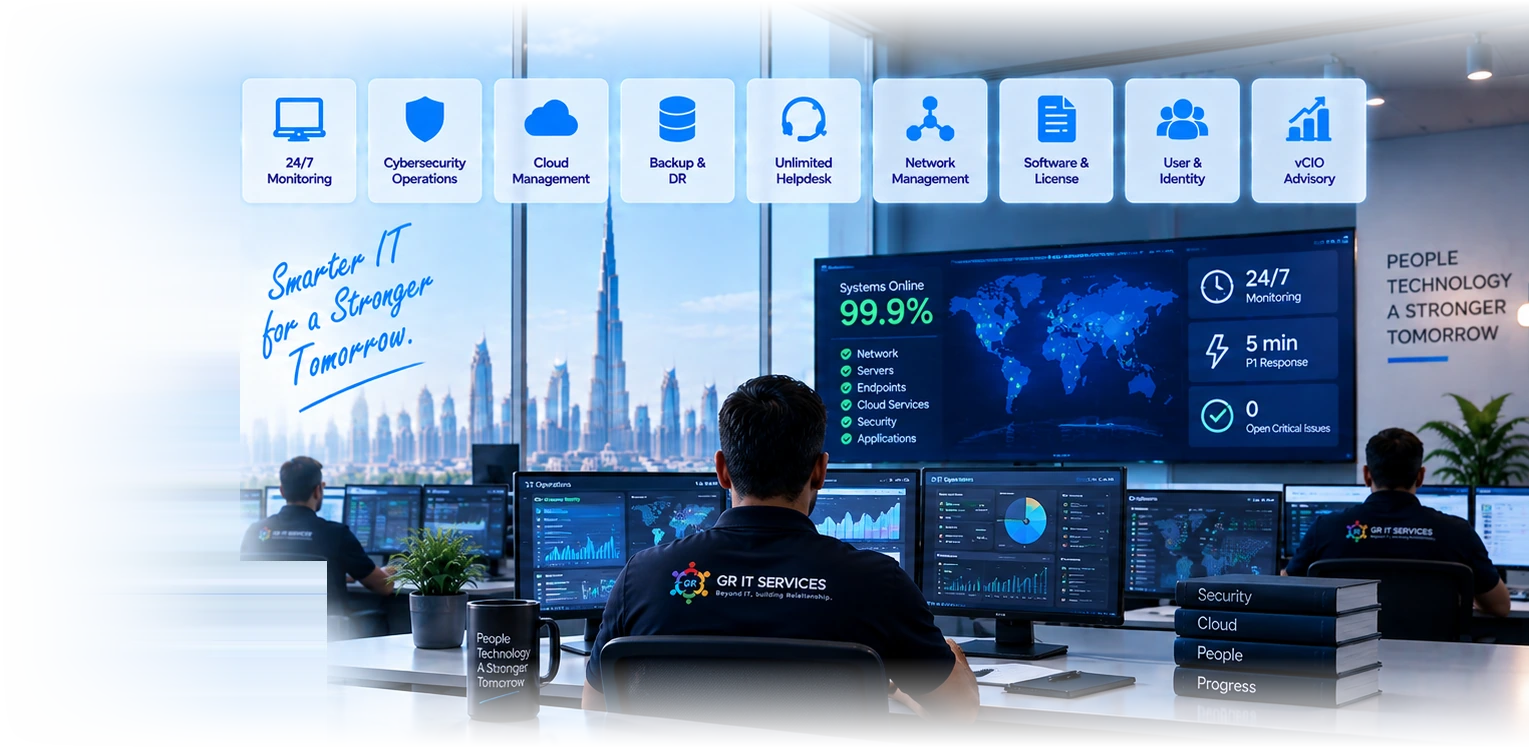
GR IT Services managed IT operations centre with monitoring dashboards across multiple screens
  • 99.9%Uptime
  • 5minP1 Response
  • 24/7Coverage
  • vCIOStrategic input
What managed IT covers

Nine disciplines, owned end-to-end.

You stop hiring. We become your IT department. Strategy, operations, security, support, vendor relationships, the whole estate sits with us under one contract.

24/7 monitoring

Servers, endpoints, network, cloud workloads, and security telemetry watched continuously. Most P1 incidents resolved before users notice anything was wrong.

Cybersecurity operations

Endpoint protection, EDR, MFA enforcement, patch management, threat hunting. Quarterly penetration testing on Professional and Enterprise tiers.

Cloud management

Azure, AWS, M365, hybrid environments. Cost optimization, security baselines, capacity planning, migration runbooks. Full IaC where appropriate.

Backup & DR

Automated backups verified daily, off-site copies, written recovery runbooks. RPO and RTO targets agreed with you and tested annually, not just promised.

Unlimited helpdesk

No ticket cap, no hour bucket. Phone, email, ticket, chat. P1 5min, P2 10min, P3 30min, measured against the contract.

Network management

Routers, switches, firewalls, wireless, VPN. Configuration as code. Continuous monitoring. Site rebuilds when something fails, no callout fee.

Software & license

Procurement, deployment, license tracking, renewal management. Track every license you pay for; cancel the ones you do not use.

User & identity

Active Directory, Entra ID, joiner/mover/leaver workflows, conditional access policies, MFA rollout, privileged access management.

vCIO advisory

Quarterly strategic review with a senior consultant. Roadmap, budget planning, vendor evaluation, risk register. Board-ready briefings included.

Comprehensive Managed IT Services Portfolio

Three pillars, owned end-to-end.

Every managed-IT contract maps work into the same three pillars: infrastructure and operations, security and compliance, support and management. Below is what we cover in each, and the tooling we run.

Infrastructure & Operations

Core IT foundation management: monitoring, multi-cloud, networking, and virtualization.

  • 24/7 proactive monitoring with SNMP, RMM, APM
  • Multi-cloud orchestration: Azure, AWS, GCP
  • Software-defined networking with SD-WAN, VLAN, QoS
  • Virtualization on VMware, Hyper-V, Docker, Kubernetes
  • Cost optimization, auto-scaling, hybrid cloud integration
  • Capacity planning and performance baselines

Security & Compliance

Zero-trust security, immutable backups, identity management, and continuous compliance.

  • Zero-trust architecture: XDR, SIEM, 24/7 SOC monitoring
  • Immutable backup and DR: 3-2-1 strategy, RTO under 1 hr, RPO under 15 min
  • Identity and access management: SSO, MFA, PAM, ZTNA
  • GRC and compliance: ISO 27001, GDPR, SOC 2, PCI DSS
  • Quarterly penetration testing on Professional and Enterprise
  • Audit-ready evidence and continuous control attestation

Support & Management

Omnichannel helpdesk, asset management, workplace transformation, and analytics.

  • Omnichannel helpdesk: ticket, phone, email, chat, AI assistant
  • IT asset management: CMDB, software metering, license optimization
  • Workplace transformation: VDI, MDM, BYOD enablement
  • Performance analytics: BI dashboards, capacity planning
  • P1 5min, P2 10min, P3 30min response SLA
  • Self-service portal and knowledge base
Why GR IT for managed services

Four reasons clients pick managed over building in-house.

Managed services replaces a 3-5 person in-house IT team. Here is why that math works for most Dubai mid-market businesses.

Senior team from day one

30+ engineers including networking, security, cloud, M365 specialists. You get the full bench, not one generalist hire stretched thin.

Brand-agnostic

Dell, HP, Lenovo, Apple, Cisco, Fortinet, Sophos, Microsoft, AWS. We service the stack you have, not just brands we resell.

Roadmaps, not just tickets

vCIO advisory means we plan ahead. Hardware refresh schedules, security maturity steps, cloud migration phases, all in writing.

Four years of operations

Pattern recognition from running over 100 managed estates. We have already debugged the issue your team is about to hit.

UAE expertise, Dubai operations

Three reasons our managed-IT engagements stick in the UAE.

Local presence, certified Microsoft practice, and the operating scale to keep both running every day of the year. The detail behind each card is the part most clients ask about in references.

Trusted since 2022

Four years of UAE-specific managed-services delivery. The patterns we have seen, you have not yet hit. We know the regulators, the carriers, the Friday-night incidents.

  • Founded and headquartered in Dubai
  • Four years of unbroken UAE managed-IT operations
  • NESA, DIFC, ADGM, DHA familiarity
  • Local team, not an offshore desk

Microsoft Partner

Microsoft Solutions Partner with current designations across Modern Work, Security, and Infrastructure. The licensing conversation, the M365 incident response, the Defender deployment, all on our certified bench.

  • Microsoft Solutions Partner designations
  • Engineers certified MS-100, AZ-104, SC-200, SC-300
  • Direct routing into Microsoft Premier support
  • Licensing optimisation for M365 and Azure

800+ systems under management

800+ endpoints, servers, network devices, and cloud workloads under continuous management across the active book. Native Arabic and English support so the business owner and the IT admin both get the conversation in their language.

  • 800+ systems under continuous management
  • Native Arabic and English support
  • 24/7 NOC running from Dubai, not offshored
  • Bilingual reporting and quarterly reviews
Industries we cover

Managed IT profiles by sector.

Six sectors where managed IT consistently beats hiring in-house. Tier and scope vary, the operational discipline does not.

Mid-market offices

50-250 staff offices. Too big for AMC, too small to staff a full IT team. Managed IT covers the whole estate at the cost of one senior hire.

Professional services

Law firms, accounting practices, consultancies. Document management, secure remote access, regulatory documentation. vCIO covers the partner conversation.

Retail & multi-location

Multiple stores, central HQ, distributed POS, customer WiFi. Centralised monitoring, standardised store builds, weekend coverage.

Healthcare groups

Multi-clinic groups, hospital IT departments. PHI handling, regulatory documentation, integration with PACS, HIS, and patient portals.

Education

Schools, universities, training providers. Student device fleets, exam systems, parent portals, content filtering, regulatory reporting.

Manufacturing & logistics

OT/IT convergence, ERP support, warehouse WiFi, EDI integration, scanner fleets. Operations technology where downtime stops production.

Technologies we master

Expert support across every major platform.

Twelve platforms covering the stack you actually run, from Microsoft and cloud providers through to networking, security, and end-user hardware. Anything not on the list, we still triage and route to the right specialist.
Microsoft 365
Microsoft 365
Microsoft Azure
Microsoft Azure
Amazon Web Services
Amazon Web Services
Google Cloud
Google Cloud
Apple
Apple
VMware
VMware
Cisco
Cisco
Fortinet
Fortinet
Sophos
Sophos
Dell
Dell
HP
HP
Lenovo
Lenovo
Managed IT vs in-house IT department

What you actually get for the managed fee.

Building an in-house IT team for a 100-person business typically means 3-5 hires, a manager, and 18 months of recruiting. Honest comparison:
Coverage hours
In-house IT teamOffice hours, holidays off
Managed IT24/7, holidays included
Specialist depth
Networking, security, M365, cloud, hardware. You cannot hire one person who is senior in all of them.
In-house IT teamLimited by team size
Managed IT30+ specialists on call
Annual cost (mid-market)
In-house IT teamAED 800k-1.5M salary + overhead
Managed ITFrom AED 144k contract
Cost on a sick week
In-house IT teamYou're uncovered
Managed ITSame fixed fee
P1 response SLA
In-house IT teamBest-effort
Managed IT5 min, contracted
Strategic IT input (vCIO)
In-house IT team
Managed ITQuarterly review included
Scaling up or down
Hiring takes 6 months; firing takes longer.
In-house IT teamSlow, painful
Managed ITMid-month tier change
Feature
In-house IT team
3-5 hires + manager
Managed IT
Full team, fixed fee
Coverage hours
Office hours, holidays off24/7, holidays included
Specialist depth
Networking, security, M365, cloud, hardware. You cannot hire one person who is senior in all of them.
Limited by team size30+ specialists on call
Annual cost (mid-market)
AED 800k-1.5M salary + overheadFrom AED 144k contract
Cost on a sick week
You're uncoveredSame fixed fee
P1 response SLA
Best-effort5 min, contracted
Strategic IT input (vCIO)
Quarterly review included
Scaling up or down
Hiring takes 6 months; firing takes longer.
Slow, painfulMid-month tier change
Before you sign anything

The three clauses that cost UAE businesses the most.

We have taken over environments from more than a dozen previous providers. The damage is rarely technical incompetence. It is almost always one of three contract terms that looked harmless at signature and turned into a trap eighteen months later. Read your current agreement for these three before you renew it, whoever your provider is.

  • Provider-owned tenancy. If the Microsoft 365 tenant, Azure subscription, or domain registrar sits in the provider partner account rather than yours, migrating away means rebuilding identity from scratch. Check who the registered global administrator is today, not who has access.
  • Auto-renewal with a narrow cancellation window. A twelve-month term that renews automatically unless cancelled between 90 and 60 days before expiry is a term designed to be missed. Diarise the window the day you sign, or negotiate it out.
  • Documentation produced only on exit. If the contract says handover documentation is prepared at termination, you have no leverage at the moment you most need it. Documentation should be a continuous deliverable you can read any Tuesday.
Have us review your current contract
Response SLA

Operational SLA, not marketing copy.

Three priority tiers, classified at intake. Response is the time to first engineer action, measured and reported monthly.
P1Critical, business stopped
5 minresponse

Resolution target

Within 4 hours

Example incidents

  • Production systems down site-wide
  • Active security incident or ransomware
  • Loss of internet or core network
  • Data loss event with active impact
P2High, single team or function blocked
10 minresponse

Resolution target

Within 1 business day

Example incidents

  • Single department cannot work
  • EOD batch job failed
  • Backup or replication job failed
  • Critical user account locked or compromised
P3Standard, work continues
30 minresponse

Resolution target

Within 3 business days

Example incidents

  • New user onboarding
  • Software install or licence change
  • Non-critical configuration change
  • How-to or training question

P1 coverage is 24/7 across all tiers. P2 and P3 follow contracted hours unless full 24/7 is added. SLA misses are documented in the monthly report and credited per the contract.

Who does what

The responsibility split, written down before anything goes wrong.

Most managed-IT disputes are not about competence, they are about an assumption nobody wrote down. This is the default split we contract to. It is adjustable per client, and whatever we agree goes into the service description so there is never a question at 2am about whose job something was.
AreaGR IT ServicesYour teamJoint
Service desk and user supportOwns end to end, all tiers, all hours for P1Reports issues, provides business contextAgrees priority definitions annually
Endpoint fleetImaging, patching, encryption, endpoint protection, lifecycle trackingApproves the refresh budget and standard buildAgrees the hardware standard per role
Identity and accessRuns Entra, conditional access, MFA, privileged accessOwns the joiner, mover, leaver trigger from HRQuarterly access review and attestation
Backup and recoveryConfigures, monitors, and restore-tests on scheduleSigns off the RPO and RTO the business can live withAnnual full disaster-recovery exercise
Security operationsDetection, triage, containment, forensics, reportingApproves the containment mandate in advanceIncident-response plan and tabletop exercise
Line-of-business applicationsFirst-line support, vendor liaison, integration and accessOwns the vendor commercial relationship and roadmapEscalation to the software vendor
Network and connectivityFirewall, switching, wireless, VPN, monitoringOwns the ISP contract and circuit commercialsCarrier escalation during an outage
Compliance evidenceProduces technical evidence and control documentationOwns the regulatory relationship and submissionsAudit preparation and auditor walkthroughs
Budget and strategyvCIO builds the roadmap and models the costApproves spend and sets business prioritiesQuarterly business review and annual planning
How it works

From discovery to first quarterly review.

Managed IT replaces an in-house team. The transition is structured, written, and reviewed at each milestone.
  1. 1

    Discovery

    1-2 weeks

    Full audit of your current estate: hardware, network, cloud, software, identity, security posture, and existing processes. Output: a written gap-and-risk register.

  2. 2

    Transition

    2-4 weeks

    Monitoring agents deployed, runbooks built, escalation paths defined. Knowledge transfer from your existing team or vendor. We are operating in shadow mode by week 2.

  3. 3

    Operations

    Ongoing

    Tickets, scheduled changes, monthly reports, security operations. The day-to-day of the contract. SLAs measured and reported, never quietly missed.

  4. 4

    Quarterly review

    Every 90 days

    vCIO session: roadmap progress, risk register, budget, vendor performance, recommended next investments. Board-ready briefing included on Enterprise tier.

The first 90 days in detail

What actually happens between signature and steady state.

The onboarding period decides whether a managed-IT relationship works. Most of the value, and most of the risk, sits in these first three months. Every phase below has written deliverables you receive, so progress is visible rather than asserted.
  1. 01
    Weeks 1 to 2· 10 business days

    Discovery and documentation

    Two engineers and a project lead map the estate end to end. Every endpoint, server, switch, firewall, printer, cloud tenant, SaaS subscription, line-of-business application, and third-party integration is inventoried. We read the network rather than trusting the diagram we were handed, because the diagram is almost always two office moves out of date. Credentials are collected into a managed vault, orphaned administrator accounts are identified, and licence entitlements are reconciled against actual assignment. This is also where the uncomfortable findings surface, and we put them in writing rather than quietly working around them.

    • Full asset register with lifecycle and warranty status
    • Network topology and comms-room documentation
    • Licence reconciliation with unused and over-assigned SKUs listed
    • Risk register ranked by severity with remediation effort
  2. 02
    Weeks 3 to 4· 10 business days

    Instrumentation and critical remediation

    Monitoring agents deploy to every managed device, alert thresholds are tuned against your actual baseline rather than vendor defaults, and the service desk goes live with your users. In parallel we close the critical items from the risk register: unsupported operating systems, missing endpoint protection, expired firewall subscriptions, dormant privileged accounts, and any backup job that has never been restore-tested. Backup restoration is proved by actually restoring, into an isolated environment, with the result documented. A backup nobody has restored is a hypothesis, not a control.

    • Monitoring and alerting live across all managed assets
    • Service desk live with named engineers introduced to your team
    • Verified restore test evidence for every protected workload
    • Critical security gaps closed and evidenced
  3. 03
    Weeks 5 to 8· 20 business days

    Standardisation and root-cause work

    The recurring tickets get fixed at the cause rather than the symptom. This is where ticket volume drops hardest: the printer that jams every Monday turns out to be a driver deployed inconsistently across three device groups, and the VPN that drops at 4pm turns out to be an ISP handoff misconfiguration nobody had escalated. Patch policy, endpoint baselines, conditional access, and onboarding and offboarding runbooks are standardised and documented so that a new starter is provisioned identically every time by whoever is on shift.

    • Standardised patch and endpoint baseline policies
    • Documented joiner, mover, leaver runbooks
    • Root-cause register for the top ten recurring ticket types
    • First monthly service report with SLA performance
  4. 04
    Weeks 9 to 12· 20 business days

    Roadmap and first quarterly review

    The vCIO presents the twelve-month roadmap to your leadership: hardware refresh schedule with budget by quarter, security maturity plan mapped to the framework that applies to you, cloud and licence rationalisation, vendor consolidation opportunities, and the risks we recommend accepting rather than spending on. It is a business document, not a technical one, and it is written so a finance director can model it. From here the rhythm settles: monthly reporting, quarterly reviews, and an annual posture re-assessment against the day-one baseline.

    • Twelve-month technology roadmap with quarterly budget
    • Security maturity assessment against your applicable framework
    • Licence optimisation recommendations with annual saving modelled
    • Signed-off steady-state service description
“We were about to hire a third IT person when our finance director asked us to model managed IT instead. The math was obvious within an hour. Two years in, our uptime is up, our security posture is meaningfully stronger, and our IT line is 40% lower than the in-house plan would have been.”
Saeed Al Marri
CFO · Levantine Holdings, mid-market group, Business Bay
40% IT cost reduction vs in-house plan
Real IT transformation stories

Three UAE clients, three before-and-after outcomes.

Drawn from real managed-IT engagements over the last 24 months. Names changed, scenarios real. The transformation is the part to focus on, that is the path you are buying into.
Trading company, Sharjah
Challenge

Internal IT team overwhelmed: weekly server crashes, failed backups, no cybersecurity. Ransomware hit cost AED 850k in lost trading and 3 days of downtime. IT was the bottleneck on growth.

What we did

Full managed-IT transition: 24/7 monitoring deployed, immutable backups stood up, EDR and conditional access rolled out tenant-wide, runbooks documented for the next incident.

Outcome

Zero unplanned downtime across 18 months, 60% IT cost reduction, leadership refocused on growth.

18 months zero downtime
Mid-market group, Business Bay
Challenge

About to hire a third in-house IT person. Finance director asked operations to model managed IT instead. Decision needed inside two weeks.

What we did

Discovery audit completed in 9 days, written tier proposal with 3-year cost model. Onboarded onto Managed IT Professional in 5 weeks; in-house generalist stayed on as the relationship lead.

Outcome

40% lower total IT cost than in-house plan, uptime up, security posture meaningfully stronger.

40% cost reduction
Manufacturing group, Al Quoz
Challenge

OT/IT convergence project stalling. ERP outages every fortnight, warehouse WiFi unstable, no vCIO advisory in place to plan the modernisation roadmap.

What we did

Network rebuild with SD-WAN, ERP environment migrated to managed-cloud baseline, OT segmentation hardened, quarterly vCIO sessions started for the executive committee.

Outcome

ERP availability up to 99.97%, modernisation roadmap delivered in writing, board-ready briefings every quarter.

99.97% uptime
Common questions

Managed IT, frequently asked.

AMC is a fixed monthly contract for hardware, network, M365, cybersecurity baseline, and reactive support, sized around your office. Managed IT is everything in AMC plus full operational ownership, vCIO advisory, quarterly strategy reviews, and roadmap planning. Most clients on Standard AMC eventually graduate to Managed IT Professional once their environment grows past 50 endpoints.

It depends on size and culture. Mid-market clients (50-250 staff) usually keep one or two in-house people for hands-on/relationship work and let us handle everything else. Larger clients let us run the entire IT function. We design the engagement around what you have.

Three options: parallel run (we operate alongside existing staff for a quarter), gradual transition (we take over function by function), or clean handover (your team moves on, we own everything from day one). Most clients pick option 2.

A senior consultant (typically 10+ years experience) attends your quarterly review with a written roadmap: hardware refresh, security maturity, cloud strategy, vendor consolidation, budget planning. They are also reachable for ad-hoc strategic questions throughout the quarter, not just at the review.

Quarterly external penetration testing on Professional and Enterprise tiers, internal vuln scanning on all tiers. Full annual penetration test (external + internal + social engineering) is included on Enterprise, available as add-on on Professional.

They stay yours. We do not lock vendor relationships into our books. We will manage them on your behalf, audit utilization, and recommend renegotiation or cancellation where it saves you money. Some clients consolidate licensing through us; others prefer to keep direct relationships. Either works.

Standard onboarding: 4-6 weeks from contract signature to full operations. Accelerated onboarding: 2 weeks if your environment is well-documented and you have stakeholder availability. We have onboarded clients in 7 days when the situation demanded; we will tell you up front whether your timeline is realistic.

They are documented in the monthly report with root cause and corrective action. Service credits per the contract apply automatically (no need to ask). Recurring misses trigger an escalation review with our delivery director. We have lost zero managed-IT clients to SLA disputes in the last five years.

60-day notice on Managed IT (longer than AMC because handovers are more involved). We hand over runbooks, monitoring, asset register, license inventory, security documentation, and vCIO roadmap notes. Your environment stays operable from day one of the next vendor.

You do, always. Your Microsoft 365 and Azure tenants are registered to your domain under your global administrator account, and you hold that account. We work through delegated administration and privileged identity management with just-in-time elevation, every action logged in your own audit log where you can read it without asking us. Firewalls, switches, and hypervisors keep a customer-owned break-glass account that we never rotate without written notice. The test of a healthy MSP relationship is whether you could lock us out tomorrow afternoon and still run your business. With us you can, and we will show you exactly how during onboarding.

Project work outside steady-state operations is quoted separately: office moves and new-site builds, ERP or line-of-business application implementation, structured cabling, major cloud migrations, custom development, and hardware purchase itself. Third-party licence costs are passed through at cost and shown as a separate line. Out-of-scope work is always quoted and approved in writing before anyone starts, never billed after the fact. Everything in day-to-day operations, unlimited remote support tickets, on-site attendance within your band, monitoring, patching, backup administration, security operations, user onboarding and offboarding, and the vCIO relationship, is inside the monthly fee with no per-ticket charge.

P1 incidents are covered 24/7/365 including Eid, National Day, and the entire weekend, with the same 5 minute response target that applies at 10am on a Tuesday. There is no separate after-hours number and no answering service: the same engineers who know your estate hold the on-call rotation. P2 and P3 tickets raised outside business hours are triaged immediately and worked the next business morning unless you have bought extended-hours coverage. Change windows for patching and upgrades are deliberately scheduled out of hours, which is why most clients never see maintenance during their working day.

We tell you in writing within the first two weeks, with evidence, and we do not use it as a pricing lever. Discovery routinely surfaces things the client did not know: unpatched domain controllers, backups that have never been restore-tested, shared administrator passwords in a spreadsheet, an expired firewall subscription, a former employee whose account is still active. These land in a remediation plan with severity, effort, and cost, and you decide the order. Critical security items we fix immediately at no extra charge because operating an environment we know is exposed is not something we are willing to do.

Pricing is per user per month with a floor, quoted after discovery, and we do not publish rate cards because two companies with 60 staff can differ by a factor of two in real cost. The drivers that matter are: number of physical sites and their distance bands, whether you run on-premises servers or are fully cloud, the number of line-of-business applications we have to support, your regulatory regime, the security tier you need, and how much technical debt discovery finds. Environments that are already standardised on Microsoft 365 with modern endpoints price near the bottom of the range. Multi-site estates with legacy servers, mixed hardware, and a compliance obligation price near the top. You get one written number covering everything in scope, not a base fee with a list of add-ons.

Four things you can verify rather than take on trust. First, you get named engineers, and you will know their names, not a rotating pool behind a shared inbox. Second, the monthly report includes the SLA misses, not just the wins, because a report with no bad news is a report nobody is reading properly. Third, the exit terms are written to be usable: 60 days, full documentation handover, no data hostage, no de-provisioning fee. Fourth, ask for a reference client in your own industry and district and call them without us on the line. Every claim on this page is one you can test before you sign anything.

Microsoft 365 and Azure both offer UAE North and UAE Central regions, and for a tenant that requires residency we provision into them and document the data map. Where a workload genuinely cannot sit in a hyperscaler region, we place it in a UAE data centre with colocation and manage it there. Backups follow the same rule: the primary and secondary copies stay in-country, and any offsite copy respects the same boundary. The residency position is written into the service description so your auditor sees a documented control rather than a verbal assurance, which matters for DFSA, ADGM, and healthcare clients in particular.

Yes, and it is common in mid-market and regulated clients who already bought a SIEM or retained a specialist SOC. We define the boundary in writing: who watches what, who is allowed to isolate a device, who leads an incident, and what the handoff looks like at 3am. The failure mode with two security parties is not technical, it is the ten minutes lost while each assumes the other is acting. A named incident commander and a single documented escalation tree removes that. We integrate with Microsoft Sentinel, and with third-party SOC platforms where the client has one.

The service desk answers in Arabic or English, whichever the caller opens with, and that is a native-speaker engineer rather than a translation layer. It matters more than buyers expect: in a lot of UAE businesses the finance director and the warehouse supervisor prefer Arabic while the technical lead works in English, and forcing everyone through one language slows down the exact conversations that resolve incidents. Monthly reports and quarterly review packs are produced bilingually on request, and user-facing documentation such as onboarding guides and security-awareness material is available in both languages so adoption does not stall at the point where someone has to read an English-only instruction.

Nothing visible to you, and that is deliberate. Every client has a named primary engineer and a named secondary who is genuinely current on the estate rather than a name on a page: the secondary works your tickets on a regular rotation, attends at least one quarterly review a year, and is on the escalation tree from day one. All estate knowledge lives in the documentation platform rather than in one person, which is why we insist on documentation as a continuous deliverable rather than an exit artefact. The single-engineer dependency is one of the most common failure modes in small UAE providers, and it is usually only discovered at the worst possible moment.

Weeks one to six are onboarding: discovery, documentation, monitoring rollout, backup verification, and closing the critical security gaps. Months two and three are stabilisation, and this is where ticket volume typically drops most sharply as the recurring problems get root-caused rather than repeatedly patched. Month three brings the first quarterly business review with the vCIO and a written twelve-month roadmap. Months four to nine execute that roadmap: hardware refresh, security maturity, licence rationalisation, whatever discovery ranked highest. Month twelve is a full posture re-assessment measured against the day-one baseline, so you can see in numbers what changed rather than being told it improved.
Buyer protection

Eleven things to demand in any managed IT contract in the UAE.

Use this against us and against anyone else you are shortlisting. Every item exists because a UAE business we later took over had been damaged by its absence. If a provider will not commit to these in writing, that answer is itself the information you needed.

Control and ownership

  • You hold the global administrator account
    Your Microsoft tenant, your Azure subscription, your domain registrar, all registered to you. A provider that owns your tenant owns your ability to leave.
  • A customer-owned break-glass account on every device
    Firewalls, switches, hypervisors, and the domain. Never rotated without written notice to you.
  • Documentation is delivered continuously, not on exit
    Asset register, network diagrams, and runbooks kept current and accessible to you throughout the contract, not assembled during a handover you had to fight for.
  • Licences and vendor contracts stay in your name
    Managed on your behalf is fine. Owned by the provider is a lock-in mechanism disguised as convenience.

The service promise, in writing

  • Response times stated separately for remote and on-site
    A single blended number is how providers avoid ever being measured. Ask for both, per priority level.
  • A defined escalation path with names and timings
    Who picks up if the first engineer cannot resolve it, and after how long. Escalation that depends on you chasing is not escalation.
  • SLA misses reported by default, not on request
    The monthly report should list what was missed and why. A report containing only good news is marketing.
  • Restore testing scheduled and evidenced
    Not "backups monitored". An actual restore, on a stated cadence, with written evidence. This is the single most commonly faked control in UAE IT contracts.

The exit, agreed before you need it

  • Notice period stated in days, with no auto-renewal trap
    Watch for contracts that auto-renew for twelve months unless cancelled inside a narrow window months in advance.
  • A defined handover pack at zero cost
    Documentation, credentials, asset register, licence inventory, and security evidence. Charging for the handover is charging you to leave.
  • Data export in a usable format within a stated window
    Ticket history, monitoring history, and backup data returned in open formats. "We will discuss it at the time" is not a term.
Further reading

Resources for IT decision-makers.

IT AMC

When AMC is the right move: hardware, network, M365, cybersecurity baseline, and SLA-backed reactive support, sized around your office.

Learn more

Cybersecurity audit

Beyond the included security baseline: a full security posture audit with penetration testing, compliance gap analysis, and a remediation programme.

Learn more

Get a managed IT proposal

Tell us about your environment. Our team scopes a discovery audit, then proposes a tier and roadmap with a written SLA.

Learn more
Ready to scope managed IT?

Talk to a senior consultant.

Three-minute form. We schedule a discovery audit (no charge, no obligation) and come back with a written tier proposal and roadmap your finance team can model.

Get a managed IT proposalSee AMC plans

Related Services

Explore more solutions that work great with this service

IT AMC Dubai

Annual maintenance contracts for IT infrastructure

Learn more

IT Support Dubai

24/7 on-site and remote IT support

Learn more

Cybersecurity Audit

Security assessment and compliance audit

Learn more

On-Call IT Support

Pay-as-you-go IT support services

Learn more
GR IT SERVICES

Leading IT services provider in Dubai,
delivering enterprise-grade solutions
for businesses across the UAE.

Microsoft CSP PartnerCISGuard

Get the Helpdesk app

Raise and track IT tickets from your phone.

Download on the App StoreGet it on Google Play
Learn more about the app

Microsoft 365

  • Microsoft 365 Administration
  • M365 Reporting & Auditing
  • Microsoft 365 Licensing
  • Microsoft Copilot
  • Microsoft 365 Apps
  • Windows 365 Cloud PC
  • Microsoft SharePoint
  • Outlook & Exchange

Security

  • Microsoft Defender
  • Microsoft Purview
  • Microsoft Intune
  • Microsoft Entra
  • Compliance Manager
  • Cybersecurity Audits
  • Copilot for Security
  • Microsoft Sentinel
  • Microsoft Priva

Infrastructure

  • Google Workspace
  • Cloud Migration Services
  • Data Analytics & BI
  • Active Directory
  • Server Management
  • Apple Business
  • Apple Jamf Pro
  • IP Telephone
  • Data Backup
  • Website Development

IT Services

  • Managed IT Services
  • IT Support Dubai
  • IT AMC Dubai
  • New Office IT Setup
  • IT Relocation
  • Remote IT Support
  • On-Call IT Support
  • Startup IT Business Kit
  • Disaster Recovery & BC

Company

  • About Us
  • Careers
  • Contact
  • Blog

Contact

  • Iris Bay Tower, Office 903,
    Business Bay, Dubai, UAE
  • +971 56 613 2743
  • hello@gritservices.ae
  • gritservices.ae

© 2026 GR IT Services. All rights reserved.

Privacy PolicyTerms of UseCookie Policy